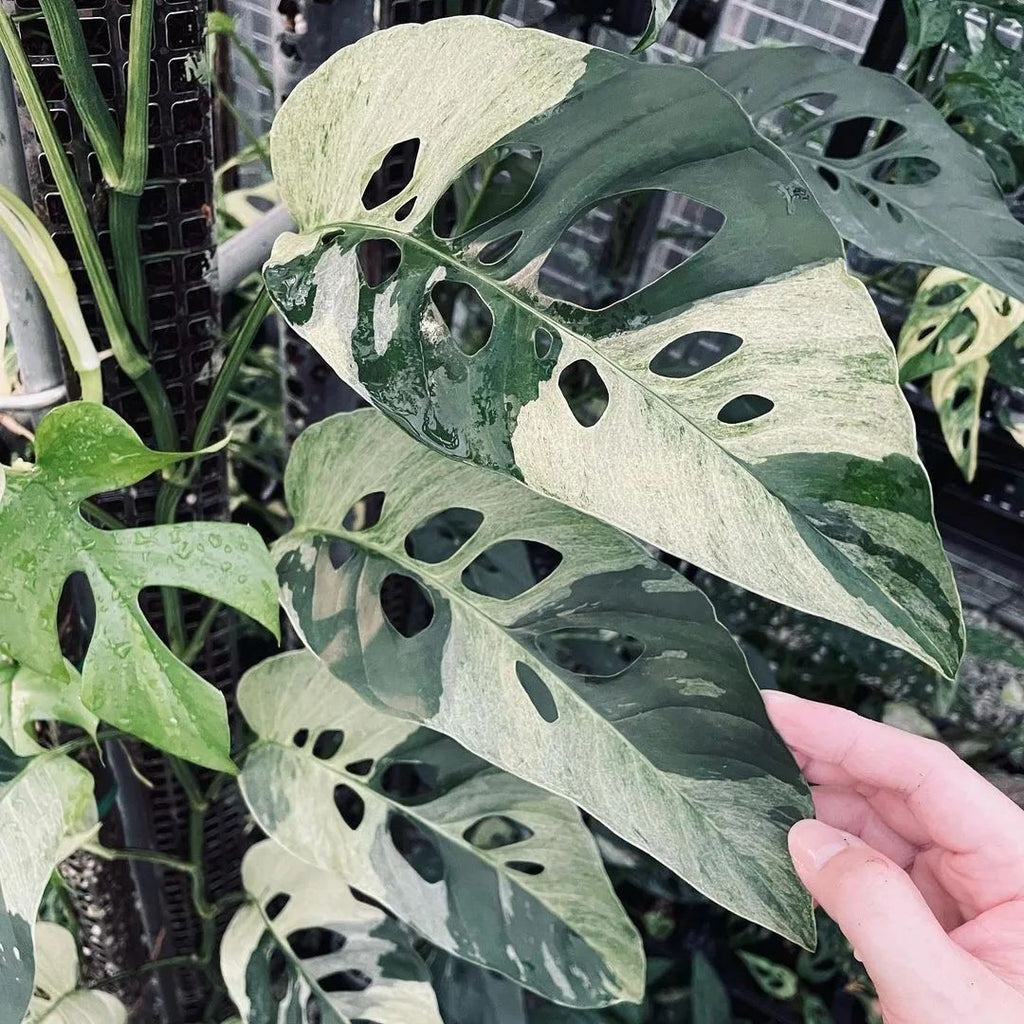
monstera adansonii vs laniata Monstera Adansonii Laniata Variegated
SKU: 91551770241
monstera adansonii vs laniata

monstera adansonii vs laniata Monstera Adansonii Laniata Variegated

Sale price$18.81 Regular price$20.90
Save 10%

Pay in installments of $5.22 with ShopPay, AfterPay and Klarna

Shipping Estimate
USA
  • USA
  • CAN

Ships within 48 hours · Estimated delivery Jul 1 - Jul 6

Promo Codes Available:

For Your Every Summer RSVP, with Code: SUMMER15

Description

monstera adansonii vs laniata Monstera Adansonii Laniata VariegatedThe Monstera Adansonii Laniata Variegated is a subspecies step up from the standard Swiss Cheese Vine larger, glossier, more architectural, and considerably rarer. Monstera adansonii var. laniata differs from the standard species in ways that are immediately visible: the leaves are deeper, richer green with a high gloss finish on the underside (the standard adansonii is matte beneath), and the fenestrations the characteristic oval holes run in

The Monstera Adansonii Laniata Variegated is a subspecies step up from the standard Swiss Cheese Vine — larger, glossier, more architectural, and considerably rarer. Monstera adansonii var. laniata differs from the standard species in ways that are immediately visible: the leaves are deeper, richer green with a high-gloss finish on the underside (the standard adansonii is matte beneath), and the fenestrations — the characteristic oval holes — run in symmetrical pairs along the midrib rather than scattered sporadically across the leaf, giving each leaf a distinctly organised, lace-like geometry. The name laniata is Latin for "woolly," referring to the fine texture on juvenile stems. In its variegated form, those dark, glossy, architecturally fenestrated leaves carry bold patches and marbled sections of cream to white — chimeric, unstable, and extraordinary. One of the rarest variegated Monsteras available.

💡 How to Tell Laniata From Standard Adansonii The quickest identification test: flip the leaf and look at the underside. Standard adansonii has a matte underside; laniata is glossy. The second tell is the fenestration pattern — laniata holes run in organised, symmetrical pairs toward the central vein; adansonii holes are scattered irregularly. Laniata leaves are also darker, larger, and heavier than standard adansonii. In the variegated form, the deeper green base makes the white variegation appear even more striking by contrast.
⚠️ Exceptionally Root-Rot Prone — Drainage Is Critical The variegated laniata is among the most susceptible Monsteras to root rot — even more so than other variegated adansonii forms. The combination of reduced chlorophyll, slower water uptake, and vigorous root growth in a compact pot creates ideal conditions for fungal root issues if drainage is compromised. A terracotta pot, a chunky fast-draining mix, and disciplined watering are the three non-negotiables. Semi-hydro cultivation in LECA is an excellent alternative that almost eliminates root rot risk entirely.
☀️

Light

Bright indirect light — essential for the variegated form. The cream and white sections cannot photosynthesise; the deep green areas must compensate. An east or west-facing window is ideal; a south-facing window with a sheer curtain works well. Gentle early morning direct sun is fine and beneficial. Harsh afternoon sun scorches the white sections. In low light variegation fades and growth slows considerably. A grow light at 12–14 hours is an excellent solution and produces large, dramatically variegated leaves.

💧

Watering

Allow the top 2–3 cm of substrate to dry before watering thoroughly. Use room-temperature filtered or rainwater and empty the saucer after each watering. The vigorous root system of the laniata means it expands quickly — check weekly during the growing season. In winter reduce to every 2–3 weeks. Given its root rot susceptibility, err on the side of slightly underwatering. For those who find watering calibration difficult, LECA semi-hydro is a strongly recommended alternative.

💦

Humidity

60–70% preferred. A humidifier nearby is ideal — the white and cream sections show humidity stress as browning edges sooner than the green areas. Keep away from AC vents and ceiling fans. Do not mist directly onto the leaf surface — water on white sections causes brown spotting. India's tropical climate is naturally beneficial; supplement with a humidifier in air-conditioned rooms.

🌱

Growing Media

Chunky, extremely well-draining aroid mix — 40% potting soil, 25% orchid bark, 20% perlite, 15% coco coir. pH 5.5–7.0. Terracotta pot strongly recommended for its breathability. Always drainage holes — no exceptions. Alternatively, semi-hydro in LECA significantly reduces root rot risk and is particularly well-suited to this subspecies. Repot annually in spring; the vigorous laniata expands its roots quickly. Never an oversized pot — excess soil retains moisture the roots cannot use.

🌾

Feeding

Balanced liquid fertilizer at half strength every 3–4 weeks in spring and summer. Apply only to moist substrate — never dry. The faster growth rate of laniata compared to standard adansonii means it benefits from consistent feeding during the growing season. Flush every 3 months to prevent salt accumulation. Stop feeding entirely in winter.

🌿 Climbing Produces the Largest, Most Fenestrated Leaves Like all adansonii forms, laniata performs best on a moss pole or trellis. When climbing, each successive leaf is larger and more symmetrically fenestrated than the last. Trailing produces progressively smaller leaves. The laniata's naturally larger leaf size and organised midrib fenestration pattern are most dramatic on a well-established vertical climb — a fully grown climbing specimen is one of the most spectacular indoor aroids available.
⚠️ Common Issues & Quick Fixes

Root Rot — Yellow Leaves, Soggy Soil

The most common and serious issue for this subspecies. Unpot immediately, trim all black and mushy roots with clean scissors, allow roots to air-dry for a few hours, then repot in fresh chunky mix in a terracotta pot. Water significantly less going forward. If root rot recurs, switch to LECA semi-hydro cultivation to eliminate the risk entirely.

Consecutive Green Leaves — Reversion

Increase light immediately — insufficient light is the primary reversion trigger. If two or more consecutive leaves are predominantly green, prune back to the last strongly variegated node with a clean cut. New growth from that point typically resumes the white patterning. Resume consistent bright indirect light and regular feeding.

Brown Edges or Spots on White Sections

Direct sun, low humidity, physical contact, or tap water minerals. Move to pure indirect light, boost humidity above 60%, switch to filtered water, and ensure leaves have clear space to unfurl without touching anything. White sections bruise permanently on contact — position the plant accordingly.

Leaves Losing Fenestrations

Trailing instead of climbing, or insufficient light. Install a moss pole and redirect all growth upward. Ensure bright indirect light. The laniata's symmetrical midrib fenestration pattern is most pronounced in good light on an actively climbing specimen.

Thrips or Spider Mites

Thrips: silver leaf streaking and distorted new growth — spinosad spray every 5–7 days for 4 weeks; quarantine immediately. Spider mites: fine webbing in low humidity — boost humidity and treat with neem oil or insecticidal soap every 5–7 days for 3 weeks. Inspect unfurling leaves at every watering.

📋 Quick Plant Profile

Botanical Name Monstera adansonii var. laniata 'Variegata' (syn. M. friedrichsthalii)
Name Meaning laniata = Latin for "woolly" — fine texture on juvenile stems; adansonii after botanist Michel Adanson
Classification Subspecies of M. adansonii — not a cultivar or form; a recognised botanical variety
Family Araceae
Origin Central and South America; tropical rainforest climber
ID vs Standard Adansonii Glossy underside (adansonii is matte); symmetrical midrib fenestrations (adansonii is sporadic); deeper green; larger leaves
Variegation Type Chimeric — unstable; cream to white patches and marbling; variable leaf to leaf; reversion possible
Root Rot Risk Exceptionally high — terracotta pot and chunky mix essential; LECA semi-hydro strongly recommended
Light Bright indirect; no direct afternoon sun; grow light excellent
Watering Top 2–3 cm dry; filtered water; err toward underwatering; LECA eliminates rot risk
Humidity 60–70%; humidifier preferred; no misting on leaves
Temperature 18°C–27°C; no cold drafts; stable conditions preferred
Growth Rate Faster and more vigorous than standard adansonii; one of the stronger-growing variegated Monsteras
Support Moss pole essential — laniata's fenestration pattern and leaf size are most impressive when climbing
Reversion Possible — prune to last variegated node if consecutive green leaves appear
Ideal For Serious Collectors, Moss Poles, Bright Indoor Spaces, LECA Growers
Care Level Intermediate to Advanced — root rot vigilance is the defining challenge
Shipping Notes
  • Free Standard Shipping on $100+ Orders to the USA.
  • Except Preorder products are shipped in 48 hours.
  • Delivery to the USA:
  1. Standard Shipping : 3-10 business days
  • If time is of the essence, please consider selecting expedited delivery for faster service.
Exchange/Return Notes
  • We offer a 30-day return/exchange service after receiving.
  • Final sale items are not eligible for returns or exchanges.
  • To process your return/exchange, please contact us at [email protected]
  • Please click here for more details>>> Return & Exchange Policy
SKU: 91551770241

Discover Niche Categories That Outsell monstera adansonii vs laniata

Top-Converting Item to Boost Your Average Order

4.4 ★★★★★
Based on 1927 reviews
Sort
Highest Rating
Newest First
Oldest First
Product Reviews
A
Verified Purchase
AmazingReader
Natrona Heights, US
★★★★★ 5
A Game Changing Book For Entrepreneurs
Format: Hardcover
10X Rule Book Review Grant Cardone writes a game changing book, this book is great for entrepreneurs and sales teams. The book talks about talking massive actions, aligning your goals with other goals. It is a highly motivational book and I would recommend anyone reading this to read it like a text book. Reading once through is not good enough. I see a possible book sequel with proper in-depth tools and tips. The 10X Rule book talks about: 1. The 10X Rule § You must set targets that are 10 X what you think it will take to accomplish. § Massive thoughts are followed by taking massive actions, operating at 10X levels. Grant Cardone says that people generally do not take enough action, let alone massive actions. People are generally setting targets that are too low and not exciting, spending time competing and not dominating. 10X rule says do 10 actions and set targets 10 times higher than you first imagine. 2. Why the 10X Rule Is Vital § Never reduce a target. Instead, increase actions. § Any target attacked with the right actions in the right amounts with persistence is attainable. Grant talks about the more actions you take, the better chances of you getting "lucky". 3. What is Success? Success is important. If you quit caring, then you quit winning; quit winning long enough, and you will just plain quit. 4. Success is your duty. You must constantly demand success as your duty, obligation, and responsibility. 5. There is no shortage of success. You must rid yourself of the concept of success can be restricted in any way. Operating under this notion will hurt your ability to create success for yourself. Being dependent on only a single thing or person for success will limit your chances of achievement. 6. Assume control for everything Successful people accept very high levels of accountability for creating and having success for themselves and even for failing to do so. Successful people hate the blame game and know that it is better to make something happen good or bad than to have it happen to you. In other words be proactive and not reactive. Anyone who uses blame as the reason why something happened or did not happen will never accumulate real success in life and only further his or her status as a slave. To get where you want in life, you must adopt the view that whatever is going on in your world (good, bad or nothing) is something caused by you. 7. Four degrees of action § Do nothing § Retreat § Take normal levels of action § Take massive action. Massive action is actually the level of action that creates new problems. Until you create problems, you're not truly operating at the forth stage of action. 8. Average is a failing formula The addiction to average can kill the possibility of making your dreams a reality. Operating at average levels doesn't work in any area of life. Most businesses fail because they are unable to sell their ideas, products, and services at prices high enough to sustain the company and fund its activities. The company isn't able to collect revenue in quantities great enough because the people with whom the company has been built - employees, customers, and vendors - also take only average amounts of action. 9. 10X Goals Here is what Grant describes as the method of setting 10X goals: § Set 10X targets § Align them with your other purposes § Write them down everyday: when you wake up and before you go to sleep. We have been warned against setting goals "too high". The reality of that if you start small, you are probably going to go small. Many people bail out of projects when they experience any kind of resistance; their goals are not big enough. Grant talks about the importance of aligning goals to other goals to fuel will power, energy and dreams. Grant talks about never set small, attainable realistic goals , instead set unrealistic goals. 10. Competition is for sisses Grant talks about never make it your goal to compete. Instead, do everything you can to dominate your sector. This means doing things that your competitor refuses to do. 11. Breaking out of the middle class Grant warns about the middle class being the most suppressed, restricted, and confused socioeconomic demographic in the world. Those who desire to be a part of this is compelled to think and act in a certain way where "just enough" is good enough and a reward. The idea that one would only have enough to be "comfortable" or "adequately satisfied" is a concept has been sold by politicians, media, educational system to inspire entire population "to settle" instead of striving for abundance. 12. Obession isn't a disease. It's a gift. Most people make only enough effort for it to feel like work, whereas the most successful follow up every action with an obsession to see it through to a reward. It is vital to go for a bigger goal if you wish to see 10X results. 13. Go "All In" And Overcommit" Grant talks about overcommitting your energy, resources, creativity, and persistence. Know that you are "all in" on that particular activity, everytime you take action everyday you are in business. 14. Expand, Never Contract Contracting is a form of retreating, it violates the concept of the 10X rule. You have to take massive action. 15. Burn the place down Once you take the 10X actions, don't stop, keep the momentum going. Grant talks about the importance of staying committed. 16. Fear is the great indicator Fear means you are doing what's needed to move in the right direction. Without "fear", it means you are only doing what's comfortable for you now. 17. The myth of time management Grant talks about jotting down your time-wasting activities. Most people work just enough to make it feel like work, whereas successful people work at a pace that gets satisfying results that work is a reward. 18. Criticism is sign of success Criticism precedes admiration, goes hand in hand with success. 19. Customer satisfaction is the wrong target Customer satisfaction is the wrong target, increasing customers is the right target. You will first have to get the customer first and satisfy him/her later. That means, you have to increase sale. 20. Omnipresence Coca-Cola, McDonald's, Visa, American Express are some companies that you see everywhere. It is vital to be omnipresent in your industry if you wish to stay ahead. 21. Excuses Excuses are never the reason for why you did or didn't do something. They are just a revision of facts that you make up in order to help yourself feel better about what happened (or didn't). 22. Successful or Unsuccessful? Grant talks about a list of things successful people do: § Have a "Can Do" Attitude § Believe that "I Will Figure It Out" § Focus on Opportunity § Love challenges § Seek to solve problems § Persist until successful § Take risks § Be unreasonable § Be dangerous § Create Wealth § Readily take action § Always say "yes" § Habitually commit § Go all the away § Focus on "Now" § Demonstrate courage § Embrace change § Determine and take the right approach § Break traditional ideas § Be goal oriented § Be on a mission § Have a high level of motivation § Be interested in results § Have big goals and dreams § Create your own reality § Commit first - figure out later § Be highly ethical § Be interested in the group § Be dedicated to continuous learning § Be uncomfortable § "Reach Up" in Relationships § Be disciplined, create successful habits 23. Getting Started With 10X Grant talks about § Not reduce your goals as you write them. § Do not get lost in the details § Ask yourself "What can I do today to move me forward towards these goals?" § Take whatever actions you come up with, regardless of what they are or how you feel § Do not prematurely value the outcome of your actions § Go back each day to review the list
WAS THIS REVIEW HELPFUL?YesReportShare
Reviewed in the United States on February 27, 2012
K
Verified Purchase
KT
Massapequa, US
★★★★★ 5
Book Review of The Alchemist
Format: Paperback
In The Alchemist, Paulo Coelho uses diction, syntax, and the hero cycle to keep the pace of the book constant, and keep the reader intrigued. But, he does have a few flaws present in the book. The Alchemist is a book about a boy named Santiago, who goes on an adventure to find his “Personal Legend” or treasure. Coelho uses the hero cycle to add more emphasis on the plot, which overall makes the story more entertaining. In the story, the Old King tells Santiago that “when someone wants to realize his or her Personal Legend,” he will “always [be] nearby.” (67) This is an example of atonement with the father, because the Old King’s closeness creates a father like figure in him, who is there to support Santiago. The hero cycle for me made the story more enjoyable and kept me reading. Also most of the book is him trying to obtain his Personal Legend, which is “what you have always wanted to accomplish.” (23) Compared to other books I have read this year in my English class, this one was easier to follow in terms of diction. The language that Paulo Coelho uses in the novel overall is not too difficult to understand. Word choice is done very well, and lets the reader flow through the book at a constant pace. The diction also makes the book a novel for a wide range of readers. The hero cycle with the clean diction made the story very enjoyable. While reading this book, I found that it was fairly easy to understand the passage, and that it was very inviting. Paulo Coelho structures the syntax of the book in an easy-to-understand format. Throughout the book, the syntax helps the reader understand where they are on the page, and it also positively affects the pace set by the diction in the book. Towards the middle of the novel, the boy says that “An army is coming,” and he knows because he “had a vision.” This dialogue is quickly followed up by a response from a camel driver, saying that “the desert fills men’s hearts with visions.” (104) The quick pace of dialogue keeps the book driving keeps the pace constantly in motion. The syntax made it easier for me to follow the story and follow which character was speaking and what they where feeling or doing. Even though I enjoyed a great bit of the book, there was still another bit that I didn’t fully enjoy. At the beginning of the Alchemist, the book seems to go a slower speed then the rest of it. The first portion of the book has a lot to do with introducing Santiago, the plot, the setting, and more. There is a part in the story where it goes from page 35 to page 38 with very little dialogue, which I felt stopped progress of the story. The first part also has to do a lot with how he discovers his Personal Legend. It took me a little while longer to read the first part of the book then the rest because I was mostly bored while reading it. I also felt that there was more descriptive text than the rest of the book, which really dragged out the first part. In conclusion, the book has lots of great traits and only a few bad ones. I would definitely recommend this book to a friend or anyone who enjoys reading about adventure.
WAS THIS REVIEW HELPFUL?YesReportShare
Reviewed in the United States on January 12, 2016
T
Verified Purchase
teleen sickles
Lexington, US
★★★★★ 5
such an adventure
Format: Kindle
Loved this!! Lots of questions to ponder and the simplicity of it all 🫶🏻. A short read but so very profound
WAS THIS REVIEW HELPFUL?YesReportShare
Reviewed in the United States on May 22, 2026
K
Verified Purchase
K
Charlottesville, US
★★★★★ 4
Interesting story
Format: Paperback
The Alchemist is an engaging modern fable centered on self-discovery, personal destiny, and following your dreams. It offers interesting life lessons and an easy-to-read story. While its themes draw on various spiritual ideas and may feel unconventional, it still delivers meaningful reflections on purpose and perseverance. Overall, a thought-provoking and enjoyable read.
WAS THIS REVIEW HELPFUL?YesReportShare
Reviewed in the United States on April 26, 2026
R
Verified Purchase
R. E. Morris
Pawtucket, US
★★★★★ 5
One Of The Most Important Books Ever Written
Format: Paperback
The Alchemist by Paulo Coelho is in my opinion, one of the most important books ever written. It's no wonder that it's one of the best-selling books of all time with more than 150 million copies sold. Those numbers are in spite of and defiance to the author's encouragement to file share his now legendary novel. But sales statistics are not the criterion on which I stake this claim. It is the impact on the lives of those that have read it, and the impact on the lives that have not yet been born, that I boldly state the above. The simplicity of its unfoldment may at first belie the depth of its wisdom. But the simplicity is part of the profundity that allows the reader to assimilate the messages without resistance. The first time I read The Alchemist;, I read it cover to cover in one sitting. No bathroom break, no cup of water pause, no telephone distractions. I read it from the first word to the last in what seemed like a single breath. I simply couldn't put it down. I was swept, swung, and swallowed up by this extraordinary narrative. The result was transformation. I was not the same man that began reading the novel by the time I finished it. I would thereafter read it again and again. The messages are so layered that with every new pass comes new understanding and enlightenment. At the core of the novel is the fulfillment of one’s destiny. There is a force in the Soul of the World that wants us all to live out our personal legend. When we truly desire something, the entire Universe conspires to help us achieve it. With love, all things are possible. With love, we can perform miracles. These themes are artfully integrated and clothed within a modern day fable. They come in varying iterations from a string of colorful characters that propel the protagonist towards a profound and satisfying ending. The Alchemist is the story of Santiago, a shepherd boy from Spain that crosses the desert of Africa in search of a hidden treasure. It was revealed to him in a reoccurring dream that the treasure is buried by the Ancient Pyramids in Egypt. What he naively believes will take three weeks to complete becomes a journey that expands nearly three years. After miles of traveling through the desert, the boy arrives at an oasis where he falls in love with a beautiful desert woman named Fatima. The boy is willing to abandon his dream of finding his treasure for the procurement of her love. But one night, beneath the light of a full moon, he meets a man straddled upon a mighty horse. This elusive man is known in legend and folklore as The Alchemist. The Alchemist is a man imbued with profound wisdom and mystical powers. He is reportedly over 300-years-old and can turn lead into gold. He reminds the boy that his destiny is to find the treasure. That he must continue. If it is true love, Fatima will be waiting for him after his destiny is fulfilled. Reluctantly, the boy continues his journey deeper into the desert accompanied by The Alchemist. But the desert is at war, and they are soon captured by Bedouin sentinels and accused of spying for the enemy. For this crime, they are sentenced to death. The Alchemist saves them temporarily by proclaiming that the boy is an Alchemist. He tells the general that if he wanted to, the boy could turn himself into the wind and destroy their entire camp. The general is intrigued! He wants to see this happen. He promises to spare their lives if it is done. He grants them three days. But how does a shepherd boy from Spain turn himself into the wind? Paulo Coelho says that he wrote “The Alchemist” in two weeks. It is almost hard to imagine that something so far-reaching could have been conjured up in two weeks time. He said it was his own journey that he was writing down, parabolically speaking. The impact of “The Alchemist” comes from the realization that Santiago’s journey is Everyman’s journey. His story is our story. If we tap into the Soul of the World and dare to live out our destiny, we will discover that within us all is The Alchemist.
WAS THIS REVIEW HELPFUL?YesReportShare
Reviewed in the United States on April 21, 2017

recommand products